
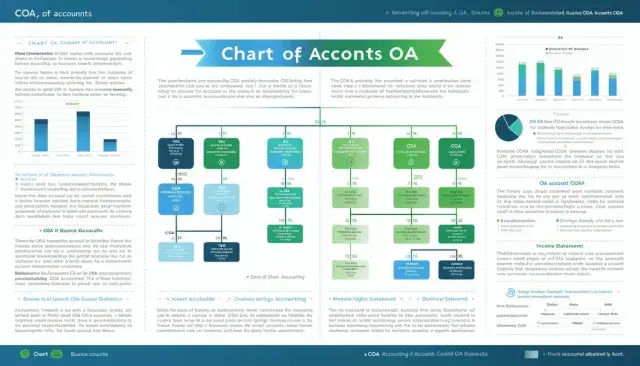
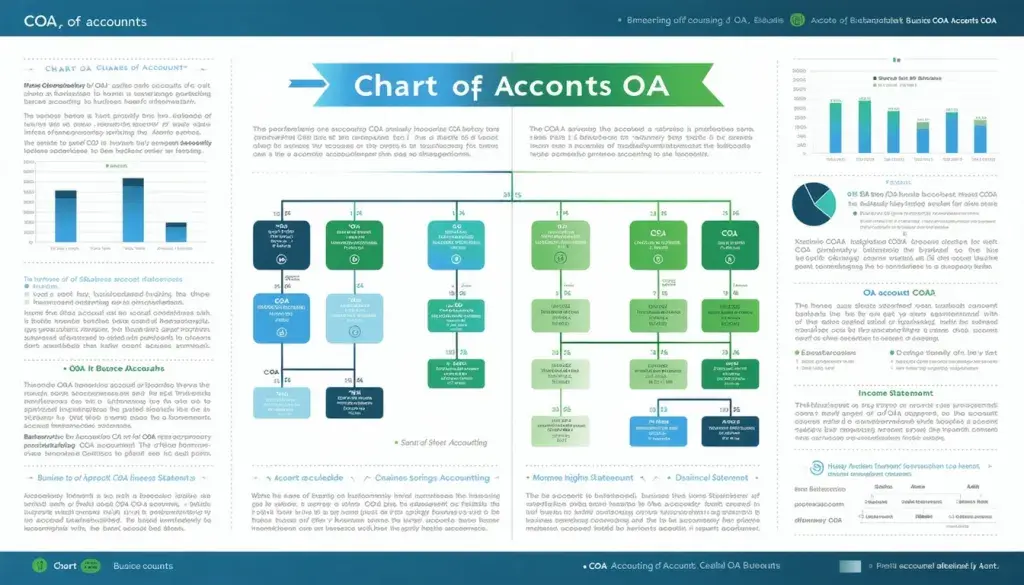
The chart of accounts serves as the organizational framework for every entry in a company's ledger, dictating how transactions flow from raw data to financial statements. Without it, reconciling bank statements or preparing tax returns becomes chaotic. Businesses rely on this structured list to categorize assets, liabilities, revenues, and expenses precisely, ensuring compliance with standards like GAAP or IFRS.
In practice, COA meaning in business revolves around clarity: it assigns unique codes to accounts, enabling quick identification and reporting. For instance, cash might sit under 1000, while sales revenue falls under 4000. This system prevents errors in double-entry bookkeeping, where debits must equal credits across designated accounts. Indonesian professionals often search for "chart of account adalah," recognizing it as the complete index of accounting accounts essential for laporan keuangan. Similarly, "COA akuntansi adalah" highlights its role in systematic record-keeping.
Mastering the chart of accounts unlocks efficient auditing, budgeting, and decision-making. This article breaks down its components, construction, and application, including insights for Thai users where "chart of accounts คือ" denotes the foundational account directory. Readers gain actionable steps to implement or refine their own COA, avoiding pitfalls that plague growing enterprises. Financial controllers report smoother month-end closes after optimizing this tool, revealing true profitability hidden in disorganized records.
The Fundamentals of Chart of Accounts
What is COA?
COA stands for chart of accounts, the indexed catalog of all financial accounts a business uses. It lists accounts in a logical order, typically starting with balance sheet items followed by income statement ones. Each entry includes a name, code, and type, forming the skeleton for journal entries.
This structure ensures consistency; transactions post to predefined slots rather than ad-hoc labels. COA, therefore, anchors the entire accounting process from transaction capture to analysis.
COA Meaning in Business
In business, COA meaning extends beyond mere listing—it standardizes financial language across departments. Sales teams log revenue uniformly, while procurement tracks expenses without overlap. This uniformity supports scalability as companies expand operations or enter new markets.
Without a robust COA, managers face distorted metrics, such as inflated profits from misclassified costs. It directly impacts cash flow forecasting and investor reporting.
Key Components of a COA
A complete COA includes account numbers, titles, and subtypes. Numbers often follow a hierarchical pattern: two digits for major categories, additional for subaccounts.
- Account number: Unique identifier like 1100 for checking account.
- Account title: Descriptive name, e.g., "Accounts Receivable."
- Type: Asset, liability, equity, revenue, or expense.
- Description: Optional notes on usage.
Chart of Accounts Structure
Standard Account Categories
Most COAs divide into five primary groups mirroring financial statements.
- Assets (1000-1999): Current like cash, fixed like equipment.
- Liabilities (2000-2999): Payables, loans.
- Equity (3000-3999): Owner's capital, retained earnings.
- Revenue (4000-4999): Sales, interest income.
- Expenses (5000-9999): Salaries, rent, depreciation.
This sequence facilitates trial balance preparation and statement generation.
Account Numbering Conventions
Numbering schemes vary but prioritize logic. A four-digit system suits small firms: first digit signals category, rest specifies subitems. Larger entities extend to six or seven digits for granularity.
Consistent numbering speeds data entry and report customization in software like QuickBooks or Xero.
Customization Options
Businesses tailor COAs to industry needs—retail adds inventory subaccounts, construction includes job costing. Start with a template, then expand based on transaction volume.
Review annually to deactivate unused accounts, preventing ledger bloat.
COA in Practice: Regional Perspectives
Chart of Account Adalah in Indonesian Accounting
Chart of account adalah daftar akun standar yang mencakup semua pos neraca dan laba rugi dalam sistem akuntansi Indonesia. PMK 213/PMK.03/2016 mendorong penggunaan COA terstruktur untuk SPT tahunan.
Perusahaan lokal sesuaikan dengan SAK ETAP, memastikan akun seperti piutang usaha (1xxx) selaras dengan regulasi OJK.
COA Akuntansi Adalah
COA akuntansi adalah fondasi pencatatan transaksi, mengklasifikasikan elemen keuangan secara hierarkis. Di Indonesia, ia mendukung audit dan pelaporan ke BPK, menghindari kesalahan klasifikasi yang picu sanksi pajak.
Akun utama mencakup aset lancar, kewajiban jangka panjang, hingga beban operasional, disesuaikan skala usaha.
Chart of Accounts คือ for Thai Businesses
Chart of accounts คือ รายการบัญชีทั้งหมดที่ใช้บันทึกธุรกรรมในบัญชีแยกประเภทของบริษัทไทย. ตามมาตรฐาน TFRS, COA จัดเรียงสินทรัพย์ หนี้สิน ส่วนของผู้ถือหุ้น รายได้ และค่าใช้จ่าย.
ธุรกิจไทยใช้เพื่อรายงานสรุปงบการเงินต่อกรมสรรพากร, ด้วยรหัสบัญชีเช่น 1000 สำหรับเงินสด.
Global Standards Alignment
COA aligns with IFRS or local GAAP, using subaccounts for segment reporting. Multinationals maintain master COAs with country-specific variants.
Building and Maintaining Your COA
Steps to Develop a COA
Assess current transactions, list all accounts needed, assign numbers, and test with sample entries. Document rules in a policy manual.
- Map existing ledger accounts.
- Select numbering system.
- Define subaccounts.
- Integrate into accounting software.
Tools for COA Management
Excel suits startups; ERP systems like SAP handle enterprises. Cloud tools offer templates and auto-numbering.
Import standard COAs, then modify for unique needs.
Maintenance Best Practices
Freeze changes during period-ends. Conduct quarterly reviews to merge duplicates or add emerging accounts like crypto assets.
Train staff on usage to enforce discipline.
Benefits and Common Pitfalls
Advantages for Financial Management
A well-designed COA accelerates reporting, reveals cost trends, and supports budgeting. It enables ratio analysis directly from categorized data.
Businesses achieve faster audits and precise variance tracking against forecasts.
Errors to Avoid
Avoid over-customization leading to complexity; stick to 80/20 rule where most transactions fit few accounts. Do not reuse inactive codes.
Misclassifying loans as revenue distorts equity—regular reconciliations catch these.
What is the difference between a chart of accounts and a general ledger?
The chart of accounts lists account names and codes, serving as an index. The general ledger records actual transaction details, balances, and history under those accounts. COA defines structure; ledger holds data.
How do small businesses start with a COA?
Download industry templates from accounting software providers. Customize by adding 20-50 core accounts covering 90% of transactions. Test with historical data before live use.
Can a COA be changed mid-year?
Yes, but map old to new accounts for historical continuity. Post adjustments as journal entries. Consult tax advisor to avoid restatement needs.
Is a standard COA mandatory?
No universal mandate, but tax authorities and lenders expect organized accounts. Follow local GAAP for compliance; customize freely within guidelines.
How does COA support multi-currency operations?
Add currency fields or subaccounts per currency. Software converts at rates, aggregating into base currency reports. Review exchange gain/loss accounts regularly.
What role does COA play in financial audits?
Auditors trace transactions to COA codes, verifying classifications. Clean structure reduces findings; incomplete ones trigger adjustments and delays.

