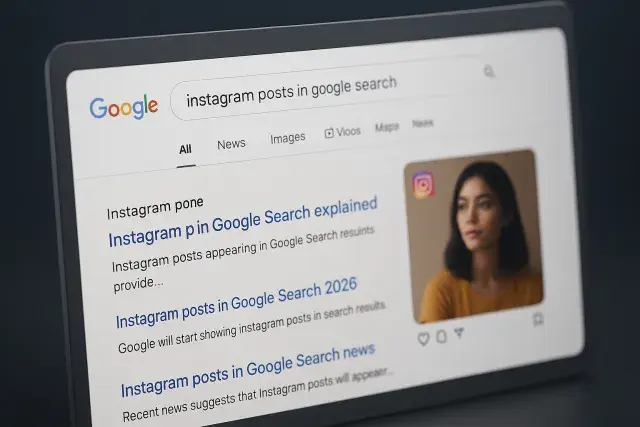
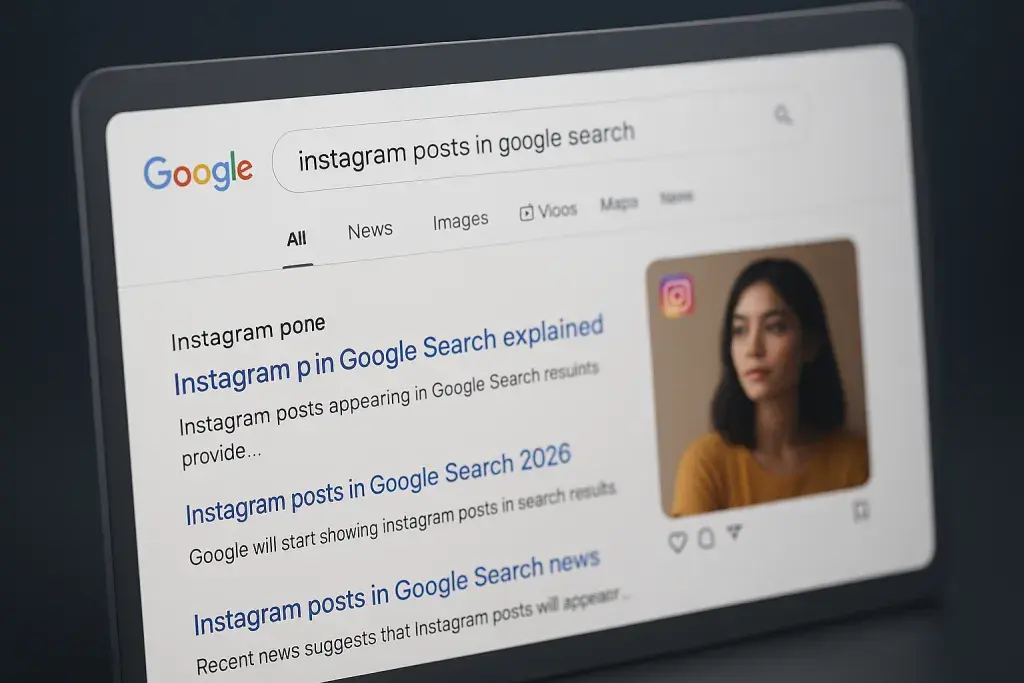
A brand's carousel post now sits a few pixels away from its own homepage in a results page, and almost nobody planned for that. For years, social platforms and open-web content lived in separate lanes: one indexed by crawlers, the other locked behind app walls and algorithmic feeds. That separation is breaking down. Instagram posts in Google Search have started appearing for ordinary queries, showing up alongside articles, product pages, and reviews in a way that catches even experienced marketers off guard.
The shift raises immediate, practical questions. Does a caption now function like a meta description? Does an account's engagement history influence whether its content gets surfaced outside the app entirely? Creators who once measured success purely in likes and saves are suddenly asking whether visibility beyond Instagram depends on the same signals. Some have already started experimenting with tactics to strengthen their content's performance, including services that boost a reel on instagram, betting that stronger engagement numbers might translate into better odds of appearing where people are actively searching.
This piece walks through what's actually happening, why it's happening now, and what it might mean for the way brands and creators think about visibility. Expect a grounded explanation of the mechanics, the reactions so far, and where this trend appears to be heading.
What Are Instagram Posts in Google Search?
At its simplest, this refers to public Instagram content - individual posts, reels, and sometimes profile previews - showing up directly in a page of search results, rather than requiring a user to open the Instagram app and search internally. Instagram posts in Google Search explained plainly: it's an extension of how crawlers already index public web pages, applied now to a category of content that used to sit largely outside that system.
This isn't identical to a business profile simply being findable when someone searches a brand name. Profile pages have been indexable for a while. What's different is that specific posts - a single reel, a single carousel - can now surface as standalone results, complete with a thumbnail, a caption snippet, and a link back to the original post.
- Single image posts with public captions and hashtags
- Reels, often prioritized due to their video format and engagement patterns
- Carousel posts, sometimes shown with a preview of the first slide
- Public profile previews that accompany branded searches
Picture someone searching for a specific product review or a niche hobby term. Instead of only web articles, they might now see a reel from a creator demonstrating the product, sitting in the same list of results as a blog post covering the same topic. That's the practical shape of this change.
How Did We Get Here? The Background Behind This Change
This didn't appear out of nowhere. It reflects two separate but converging trends: a push toward indexing more visual and short-form content generally, and Meta's own decisions about what parts of Instagram remain open to outside crawlers. Neither company acted alone here - the result is a consequence of both sides loosening restrictions that used to keep social content siloed.
Google's Broader Push Toward Social and Visual Content
Search results have steadily moved away from being a list of ten blue links. Image packs, video carousels, and short-form clips have become standard fixtures for many query types. Instagram posts in Google Search news over the past period reflects this broader pattern - a continued effort to surface content in the format users are most likely to actually want, rather than defaulting to text-based pages when a visual answer would serve better.
Instagram's Own Role in Enabling Indexing
None of this works without cooperation from the platform hosting the content. Instagram has adjusted its public content settings over time, allowing more of what's posted publicly to be visible to outside crawlers. Public accounts that once required a login wall to view fully are now, in many cases, readable enough for a snippet and thumbnail to be extracted and displayed elsewhere. Private accounts remain outside this system entirely, which matters a great deal for anyone trying to understand why some content appears and other content never does.
How Instagram Posts Actually Appear in Google Search Results
Not every public post shows up. Visibility depends on a combination of factors, some obvious and some easy to overlook. Account privacy is the first gate - a private account is invisible to this system by definition, regardless of how good the content is. Beyond that, caption clarity, hashtag relevance, and the freshness or popularity of a post all appear to play a role in whether it gets picked up and how prominently it's displayed.
| Factor | Description | Impact Level |
|---|---|---|
| Account privacy setting | Public accounts are eligible for indexing; private accounts are excluded entirely | High |
| Caption content and clarity | Descriptive, keyword-relevant captions help crawlers understand context | Medium |
| Hashtag usage | Relevant hashtags can reinforce topical signals, though they aren't a guarantee | Medium |
| Engagement levels | Higher engagement may correlate with increased visibility, though the exact weighting is unclear | Medium |
| Content freshness | Recently posted content may be prioritized for certain trending queries | Low to Medium |
Consider two accounts posting similar content. A public brand account with a descriptive caption and consistent engagement stands a reasonable chance of appearing for a branded search term. A private account, no matter how strong its content, simply won't appear at all - the privacy setting alone rules it out before any other factor gets considered. That single distinction trips up more creators than any other part of this system.
First Impressions: What Users, Brands, and Creators Are Noticing
Reactions since this started appearing more widely have been mixed, which is fairly typical for any shift that touches both discoverability and control. Brands generally see upside - an additional channel through which their content can be found by people who never opened Instagram with that brand in mind. Creators have noted similar benefits, describing unexpected traffic arriving at posts that previously would have stayed within their existing follower base.
- Increased visibility for public accounts that previously relied solely on in-app discovery
- Concerns over losing control of how content is presented outside its original context
- New traffic sources that didn't exist when content was confined to the app
- Confusion over why some posts appear while similar posts from the same account don't
That last point of confusion comes up often. A creator might see one reel surface prominently while a nearly identical post from the same week never appears at all. Without a clear published formula for indexing criteria, this randomness feels frustrating, even though it likely stems from the same combination of privacy, caption quality, and engagement discussed earlier. Instagram posts in Google Search update patterns suggest this inconsistency may smooth out as the system matures, but for now it remains one of the more common complaints.
What This Means for Visibility and Engagement Strategy
Once a creator or brand accepts that visibility outside the app is now genuinely possible, the natural next question is how to influence it. A few adjustments make sense based on what's currently understood about how this indexing works.
- Write captions that describe the content clearly, rather than relying purely on cryptic or purely promotional language
- Use hashtags that reflect actual topics covered in the post, not just trending tags unrelated to the content
- Keep the account public if outside discoverability is a genuine goal
- Maintain consistent engagement through comments, shares, and saves, since these signals may factor into visibility
- Monitor which posts appear externally and look for patterns in caption style, timing, or content type
Engagement deserves particular attention here. If interaction levels genuinely factor into whether a post gets surfaced beyond the app, then the incentive to strengthen those numbers early becomes stronger. This is part of why some creators turn to tools designed to boost a reel on instagram shortly after posting - the logic being that early momentum on likes and views might improve a post's standing both inside Instagram's own recommendation system and in how it gets treated by outside indexing. Whether that assumption holds fully true is still being tested in practice, but the reasoning behind it is sound enough that it's worth understanding.
What to Expect in 2026 and Beyond
Predicting exact behavior for Instagram posts in Google Search 2026 requires some caution, since neither company has published a detailed roadmap. That said, current trends offer a reasonable basis for informed expectation. Video content, particularly reels, appears to be gaining more prominence in visual search formats generally, and there's little reason to expect that trend to reverse.
| Aspect | Current State | Expected Direction |
|---|---|---|
| Content types indexed | Primarily public posts, reels, and profile previews | Likely broader coverage of video and carousel formats |
| Ranking factors | Caption relevance, hashtags, engagement, account privacy | Possibly more refined signals as the system matures |
| User experience | Occasional, sometimes inconsistent appearance of posts | More predictable and frequent integration into results |
None of this is confirmed by either company, and treating these projections as guaranteed outcomes would be a mistake. They represent a reasonable reading of current direction, not a fixed plan. Brands that build strategy around flexibility rather than rigid assumptions will adapt more comfortably if the details shift.
Common Mistakes and Misconceptions to Avoid
A handful of misunderstandings keep circulating as this feature gets more attention, and clearing them up now avoids wasted effort later.
- Believing private accounts can somehow still appear - they cannot, under any circumstance, as long as the privacy setting remains active
- Assuming that adding more hashtags guarantees indexing - hashtags help provide context but don't force inclusion
- Thinking this replaces the need for a proper website or blog presence - it supplements discoverability rather than substituting for it
- Expecting every public post to eventually appear - many public posts never surface externally, and there's no visible timeline for when or if they will
Clearing up these assumptions matters because strategy built on false premises tends to waste time and budget. Understanding what this feature actually does - and doesn't do - keeps expectations realistic.
Questions and Answers
Do I need to change my Instagram bio or profile settings for posts to appear in search results?
The account must be public, which is the primary requirement tied to profile settings. Beyond that, there's no confirmed bio-specific setting that directly controls whether individual posts get indexed.
Can I request that a specific post be removed from appearing in search results?
Making a post private or deleting it entirely will remove it from public visibility, which should also remove it from appearing externally. There's no separate removal request process specific to this feature at this time.
Does this affect Instagram Stories as well as regular posts?
Stories are temporary by design and typically disappear after a set period, so they behave differently from permanent posts and reels. Current indexing behavior appears focused on content that remains accessible on a profile, not ephemeral content.
Will older posts from years ago suddenly start appearing in search results?
It's possible, since indexing can apply retroactively to existing public content, not just new uploads. Whether a specific older post appears still depends on the same factors - privacy, caption clarity, and engagement - regardless of when it was originally posted.
Is there a way to see which of my posts have already been indexed?
Searching your account name alongside specific keywords related to a post's content is currently the most direct way to check. There's no official dashboard within Instagram that confirms indexing status for individual posts.
Does a verified account get preferential treatment in appearing within search results?
There's no confirmed evidence that verification status directly influences indexing likelihood. Visibility appears more closely tied to privacy settings, caption relevance, and engagement rather than account verification badges.